
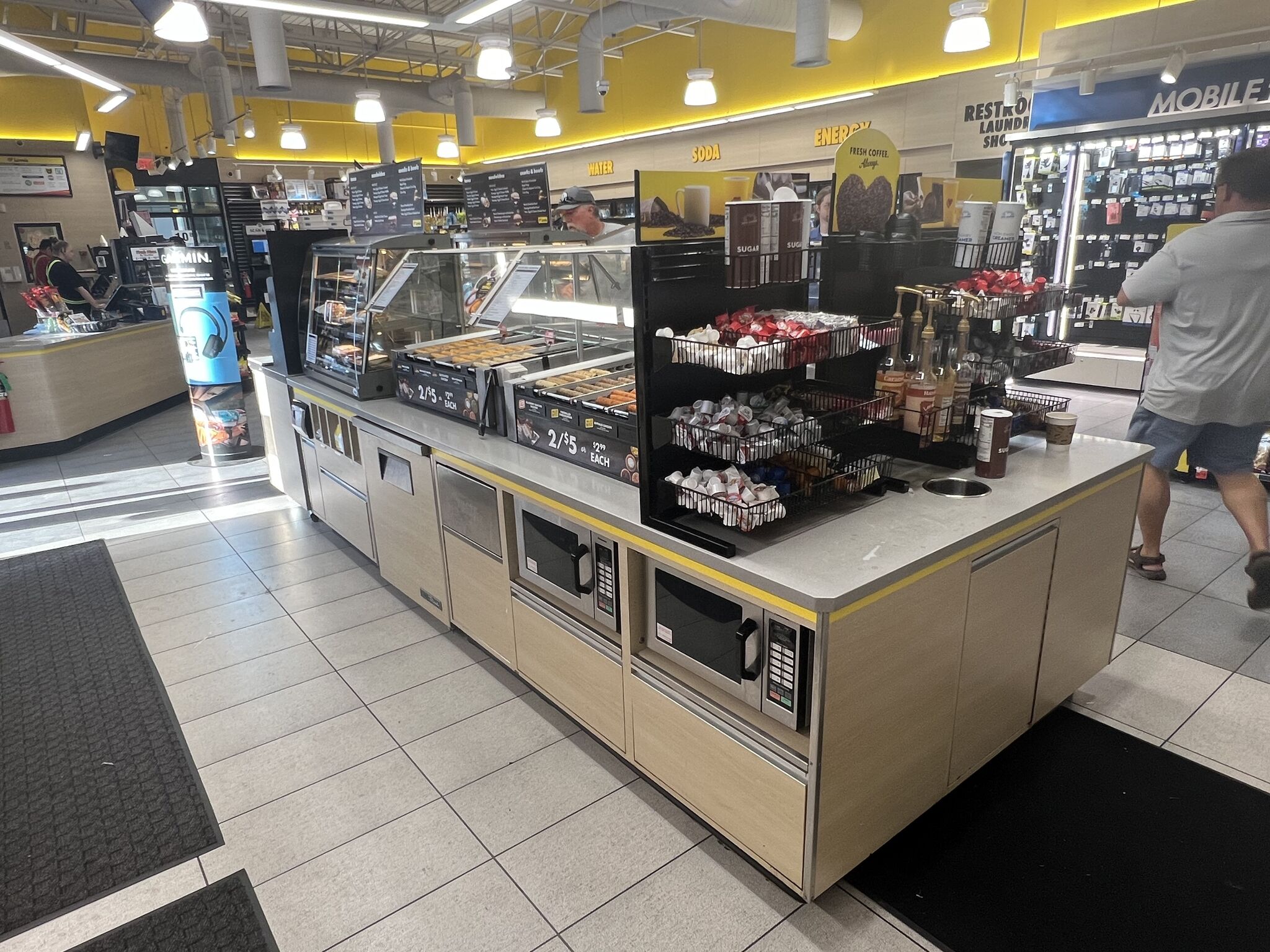
C-store foodservice concepts are evolving as retailers rethink how hot food is presented, customized and purchased.
Menus are expanding, prepared food is becoming a bigger reason to visit, and operators are balancing more choice with the need to keep the experience fast and convenient.
Two recent moves illustrate just how different those strategies can look.
Kwik Trip is simplifying one part of its hot-food program. The retailer plans to remove roller grills from more than 900 stores by September 21, while continuing to sell hot dogs, Tornados and other familiar items from its prominent hot grab-and-go cases.
At almost the same time, 7-Eleven introduced its new BiG Flavor Bar at participating 7-Eleven, Speedway and Stripes stores nationwide. The station gives customers seven proprietary sauces along with toppings and condiments they can use to customize hot dogs, pizza, sandwiches and other foods.
One retailer is reducing steps.
Another is adding choices.
Neither approach is automatically right or wrong.
The more useful question for convenience retailers is:
What can the operation execute well, consistently and profitably?
Because the right foodservice concept is the one the operation can execute consistently.
C-Store Foodservice Concepts Start With the Operation
Foodservice concepts are often evaluated from the customer’s point of view.
Does it look appealing?
Is there enough variety?
Can customers customize their food?
Is it fast?
Those questions matter. But every customer-facing decision creates requirements behind the counter and throughout the store.
A new condiment program may mean:
- more products to stock
- additional storage
- more frequent replenishment
- more surfaces to clean
- additional waste to manage
- new signage
- different employee routines
- changes to customer flow
Moving food into grab-and-go may reduce some customer steps, but it introduces its own requirements around packaging, holding, product rotation, stocking and maintaining the display.
Retail execution is where the foodservice concept becomes reality.
A strong concept that cannot be executed consistently eventually becomes a weak customer experience.
Kwik Trip: What Happens When Convenience Wins?
Kwik Trip’s roller grill decision is interesting because the retailer is not abandoning the food.
It is changing how customers buy it.
Hot dogs, Tornados and other products are moving into the retailer’s Hot Spot grab-and-go cases. According to Kwik Trip, store testing showed those products sold better from the more prominent grab-and-go location.
That distinction matters.
The lesson is not necessarily that one type of equipment is better than another.
The lesson is that placement, customer behavior and execution can be more important than tradition.
Retailers should be willing to ask:
- Is the product easy to see?
- Is the food where customers naturally travel?
- How many steps are required to complete the purchase?
- Is the current format producing enough sales for the space it occupies?
- Can employees keep the program stocked and presentable throughout the day?
Sometimes the answer may be to improve the existing concept.
Sometimes it may be to change the format entirely.
The important part is measuring what actually happens in the store.
7-Eleven: What Happens When Choice Becomes the Experience?
7-Eleven is taking a different approach.
Its BiG Flavor Bar is designed around customization. Customers can combine sauces, toppings and garnishes with hot dogs, pizza, sandwiches and other foods. 7-Eleven is even promoting suggested combinations through a “Secret Menu,” including customized roller-grill items.
From a merchandising perspective, the concept is compelling.
Customization can:
- create interaction
- make familiar products feel new
- support limited-time offers
- encourage experimentation
- give customers more control
- help differentiate a foodservice program
But customization also introduces complexity.
The operational question is worth asking:
At what point does more choice begin to compete with convenience?
More Choice Is Not Always More Value
Retailers naturally want to give customers options.
More flavors.
More sauces.
More toppings.
More sizes.
More products.
But every additional choice has an operational cost.
Another SKU needs somewhere to live.
Another topping needs a container.
Another sauce needs storage and replenishment.
Another product variation may require signage.
Another interaction may affect customer flow.
This does not mean retailers should avoid customization.
It means the physical environment needs to be designed to support the concept.
The menu can change overnight. The operation usually cannot.
That is why foodservice planning should extend beyond the equipment itself.
Look at the Entire Foodservice Environment
A successful foodservice concept is rarely the result of a single piece of equipment.
The customer experiences the whole environment:
What do I see?
Where do I go?
What can I choose?
What do I need next?
How quickly can I complete the purchase?
Employees experience another side of that same environment:
Where is replacement product stored?
Can I replenish it easily?
Can I clean around the equipment?
Can I access everything without disrupting customers?
What happens when the assortment changes?
These questions connect foodservice equipment with cabinetry, merchandising, food protection, signage, storage and customer flow.
When those elements are planned independently, small operational problems begin to accumulate.
When they are planned as one system, the concept becomes easier to execute.
Every Additional Step Has to Earn Its Place
There is an important difference between engagement and friction.
Customers may enjoy choosing a sauce.
They may enjoy building their own hot dog.
They may appreciate seeing more products.
But if the experience becomes confusing, messy or slow, those same options can become obstacles.
The same principle applies to employees.
If a merchandising fixture provides more capacity but is difficult to replenish, that capacity may not create much value.
If equipment looks great but makes cleaning harder, the operating cost may eventually outweigh the visual benefit.
If a foodservice concept offers ten choices but employees can reliably maintain only six, the additional assortment may weaken the entire presentation.
Good retail execution asks a simple question:
Does each additional element make the concept better enough to justify the work it creates?
Flexibility Matters Because Foodservice Keeps Changing
The contrast between Kwik Trip and 7-Eleven also highlights another reality.
Foodservice concepts do not stand still.
Retailers test.
Customers respond.
Menus change.
Products rotate.
Equipment changes.
Limited-time offers come and go.
New dayparts emerge.
What worked three years ago may not be the best configuration today.
That makes adaptability increasingly important.
Flexible merchandising and fixture systems can help retailers adapt the physical environment without completely rebuilding the foodservice destination every time the concept evolves.
The objective is not to predict every future menu item.
It is to create an environment capable of responding when the program changes.
Standardization Should Not Eliminate Store-Level Reality
For multi-location retailers, another challenge enters the equation.
Consistency matters.
Equipment specifications, branding, food protection, merchandising and operating procedures often need to work across hundreds or thousands of locations.
But stores are not always identical.
Footprints vary.
Traffic varies.
Customer behavior varies.
Sales volume varies.
Labor availability varies.
The strongest foodservice concepts create repeatable operating standards without assuming every store needs the exact same configuration.
That is a different idea from simply standardizing equipment.
It means standardizing the logic behind the concept while allowing the foodservice environment to respond to the realities of each location.
What Operators Should Evaluate Before Changing a Foodservice Concept
Before adding more choices, simplifying the concept or replacing equipment, look at the program from both sides of the counter.
Customer
- Can customers see the offer?
- Do they immediately understand it?
- How many steps are required?
- Does customization add meaningful value?
- Is the program positioned along the natural customer path?
- Are pricing and product identification clear?
Operation
- How much labor does the program require?
- How frequently must it be replenished?
- Is employee access easy?
- How difficult is cleaning?
- What is the waste level?
- Can the fixture or environment adapt when the assortment changes?
- Is the program producing enough sales for the space it occupies?
Those answers provide a much better foundation for a foodservice decision than simply following what another retailer is doing.
There Is No Universal Convenience Store Foodservice Formula
Kwik Trip is simplifying one part of its hot-food program.
7-Eleven is adding customization to another.
Both moves are being made in pursuit of a stronger customer experience.
And that may be the most useful lesson.
There is no single c-store foodservice concept every convenience retailer should copy.
The right solution depends on the customer, the location, the available labor, the menu, the equipment and the way employees have to operate the program every day.
A concept can look exceptional on paper.
It can photograph beautifully.
It can contain all the newest equipment.
But ultimately, the concept has to work at store level.
Because the best foodservice concept is not necessarily the one with the most choices or the fewest steps.
It is the one the operation can execute exceptionally well.
Frequently Asked Questions
What is retail execution in convenience store foodservice?
Retail execution is the day-to-day ability to deliver a foodservice concept as intended. It includes equipment, merchandising, stocking, replenishment, cleaning, product visibility, employee access, customer flow and consistent presentation.
Is more foodservice customization better for convenience stores?
Not always. Customization can create engagement and give customers more control, but it can also add operational complexity. Retailers should evaluate whether additional choices improve the customer experience enough to justify the added stocking, replenishment, cleaning and service requirements.
Why are convenience stores expanding hot grab-and-go foodservice?
Hot grab-and-go can make food highly visible and easy to purchase quickly. Its effectiveness depends on store traffic, placement, assortment, holding practices, packaging and consistent replenishment.
How should c-stores evaluate new foodservice equipment or fixtures?
Operators should look beyond equipment specifications and consider capacity, footprint, customer flow, employee access, cleaning, replenishment, merchandising, future assortment changes and sales productivity.
Why does flexibility matter in convenience store merchandising?
Menus, product assortments, promotions and equipment change over time. Flexible merchandising and fixture systems can help retailers adapt the physical environment without completely rebuilding the foodservice destination.
