
Retailers spend a lot of time thinking about square footage.
Store footprints. Shelf space. Cooler capacity. Foodservice expansion.
Every inch has a cost.
The challenge is that not every inch produces the same return.
Some areas of a Convenience Store work harder than others.
And one of the hardest-working spaces in the building may be smaller than a welcome mat.
Not All Space Is Equal
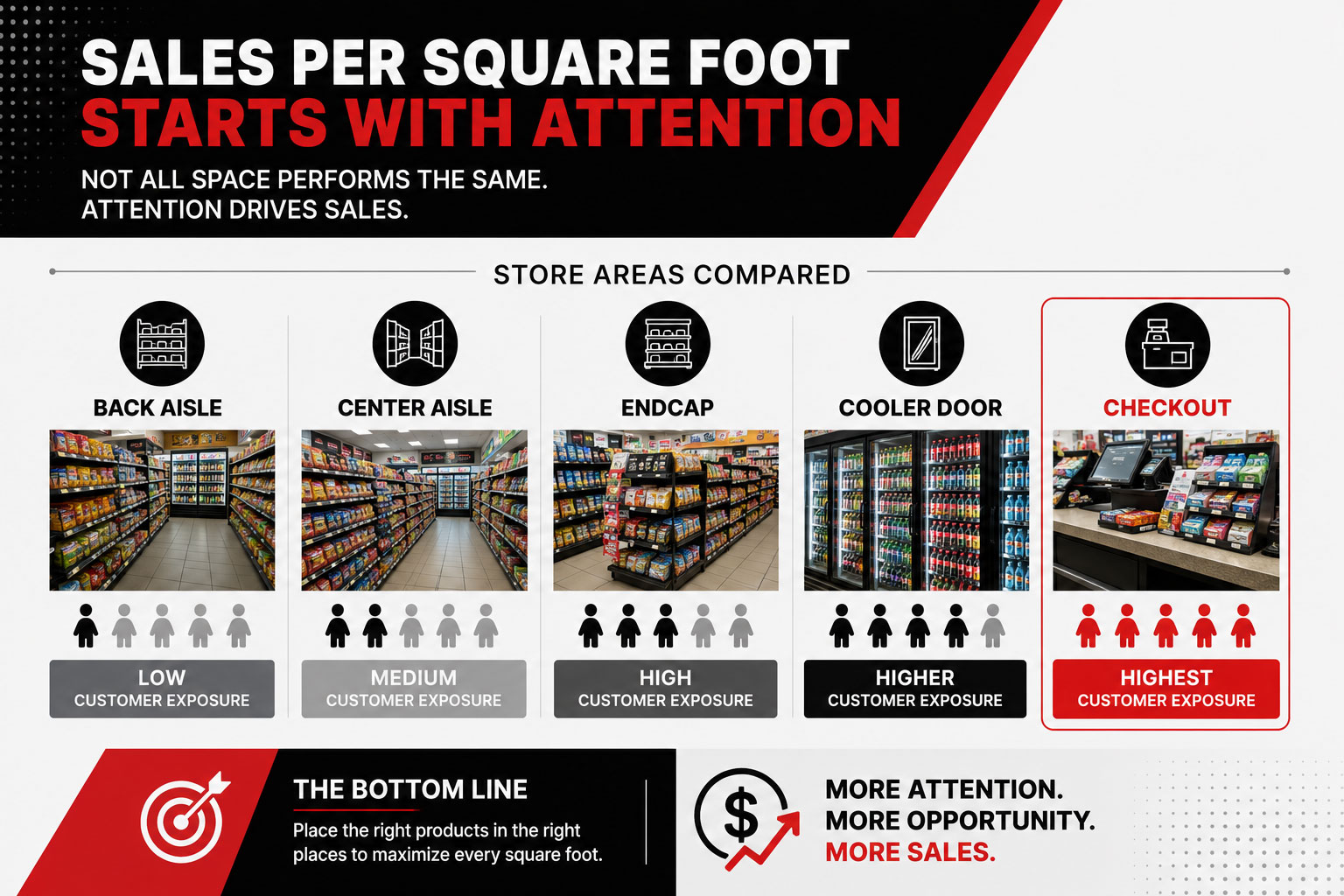
A back aisle and a checkout counter occupy the same amount of physical space, but they do not occupy the same amount of customer attention. Location has always mattered in retail.
Customers naturally gravitate toward certain areas of a store while passing through others with little notice. Retail planners often refer to these high-traffic locations as “conversion zones” because they consistently influence purchasing behavior.
According to retail research published by the National Retail Federation, product visibility and accessibility remain among the strongest drivers of unplanned purchases.
Visibility creates opportunity. Traffic creates volume. The combination creates sales.
The Economics of Exposure
Every retailer understands sales per square foot. The metric has been used for decades to evaluate store performance. What is often overlooked is that some locations within the store dramatically outperform the average.
Consider the difference between:
- A shelf halfway down an aisle
- A cooler door
- An endcap
- A foodservice pickup area
- A checkout queue
Each location receives a different amount of attention.
The checkout area receives nearly all of it.
According to the National Association of Convenience Stores’ report “U.S. Convenience In-Store Sales Top $340 Billion,” the average Convenience Store processed approximately 45,160 monthly transactions in 2025.
That equates to roughly 1,484 customer visits every day. Every one of those customers passes through the checkout area.

Very few locations inside a store receive that level of consistent exposure.
The Checkout Advantage
The register serves a unique role.
Unlike other merchandising zones, it is not optional. Customers may skip an aisle. They may bypass an endcap. They may never walk down half the store. They still visit the checkout.
That makes the area surrounding the register one of the most reliable merchandising opportunities available. Not because customers arrive intending to buy something extra. Because they arrive paying attention.
Bigger Baskets Without Bigger Stores
Convenience retailers continue searching for ways to increase revenue without increasing square footage.
That trend has become even more important as foodservice continues to grow.
NACS recently reported that foodservice generated 28.5% of in-store sales and nearly 39% of in-store gross profit dollars.
Foodservice customers create natural opportunities for add-on purchases.
A coffee becomes coffee and a protein bar. A hot dog becomes a hot dog and a beverage. A sandwich becomes lunch and a snack for later.
The increase may only be a few dollars, but across hundreds of transactions, those dollars compound quickly.
Attention Is a Limited Resource
Retailers often think about inventory; customers think about attention.
The average shopper processes thousands of visual signals every day, but most are ignored.
Products that succeed tend to share several characteristics:
- Easy to see
- Easy to understand
- Easy to grab
- Easy to justify
Researchers at the Journal of Retailing have repeatedly found that visibility and proximity strongly influence purchase decisions, particularly in low-consideration categories.
The lesson is simple. Attention is finite. The closer a product is to the decision point, the greater its opportunity.
The Constraint Every Store Faces
There is one problem. Space near the register is limited.
Cash wraps already accommodate:
- Payment terminals
- Lottery equipment
- Bags
- Promotional materials
- Employee workspace
Adding more products is easy, but adding more space is not.
The most effective retailers focus on using existing space more efficiently rather than simply adding fixtures.
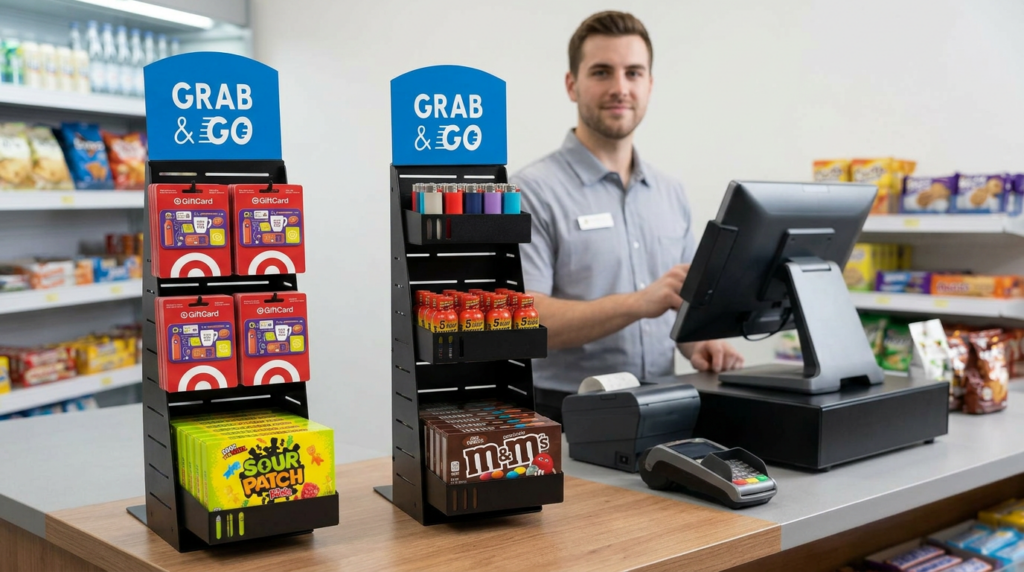
Vertical merchandising, compact displays, and edge-mounted solutions allow operators to increase visibility without disrupting traffic flow.
Thinking Beyond the Countertop
Many operators assume checkout merchandising requires valuable counter space. Increasingly, that is not the case.
Compact systems can place products directly within a shopper’s sightline while preserving operational efficiency.
Solutions such as the PanelRak® Modular Organizing System were developed around that exact challenge: creating organization and visibility in high-traffic retail environments.
The same principle applies to checkout merchandising.
The goal is not simply to add another display. The goal is to make better use of the space retailers already have.
A fixture like the PanelRak™ Impulse Merchandiser occupies a small footprint while positioning products where customer attention is already concentrated.
It doesn’t create customer demand. It helps retailers make better use of the attention that’s already there.
Final Thoughts
Retailers cannot create more square footage, but they can create more value from the square footage they already have.
The highest-performing space in a store is rarely the largest.
It is the space customers consistently see, consistently pass, and consistently engage with.
In many Convenience Stores, that space sits just a few feet from the register.
Sometimes the biggest opportunities aren’t found by adding more space; they’re found by making better use of the space you already have.
Small footprint. High visibility. Big opportunity.
